Wednesday, June 6, 2012

The Report of The TV Program on Food Waste and 2HJ; It Was a Big Success!


Written by Rumi Ide

The TV program broadcast on July 1 in Kanto region was broadcast on the national network on June 4 as well.

Viewers posted more than 700 comments on the program's twitter site, which was more than twice of the previous week.

Here is our volunteer Sonoda san talking in the program.


We loaded what Sonoda san received onto the truck.

Here is another scene of our staff's picking up food donations from other grocery stores. Masahiro Otake, 2HJ's staff member and Ozawa san, 2HJ's volunteer, are visiting a store.  


This is Akira Kawada, another 2HJ staff member, organizing our warehouse. 


Tsuyoshi Kurosawa, a 2HJ staff member, brought food to an orphanage by truck. 


Hayashi san, 2HJ's volunteer, visited one of our food donors and received Japanese rolled eggs. 

I explained that food banking is transforming food waste into a "thank-you."


Piles of food in front of 2HJ's office. 

Piles of food stored in the 2HJ warehouse. 

This pasta still has a shelf life till November 2012, but even this shelf life is too short to sell at stores, and that's why it got donated to 2HJ. 


2HJ is currently utilizing just one ten-thousandth of the food waste produced in Japan. Our challenge is how we can utilize the remaining 99.999 percent. 

Also, what is important is to cope with the root cause of food waste. I hope this program was a good opportunity for the viewers to learn and make some actions about the issue. Thank you!


A National TV Program Covered 2HJ!


Written by Rumi Ide

NHK Tokuho Shutoken, the national station's TV program, covered Second Harvest Japan (2HJ) with a focus on food waste on June 1 in Kanto region and on June 4 on the national network.

In the morning of July 4, I put up seven signs about the program around our office.

This is the door of our office we recently moved from the old one. The paper on the door is the sign about the program announcing that 2HJ will be on the national program.


Right at the side of the office entrance.


This is at our old office. The sign on the standing boards. 


A close-up of the sign in front of the old office. 


At the back entrance of the old office.


Our cargo-cycle also cooperates with advertising. 

Also on the cargo-cycle.

On June 1 and 4, the program had much more viewers than usual. Thanks to those who watched the show!

Saturday, June 2, 2012

2HJ's Ishinomaki Office and Our Assistance to Those in the Disaster Areas

Written by Yuji Shibata


It has been long since the last time I reported about our relief efforts in Ishinomaki. This time, I would like to report what we have done since last November.

Second Harvest Japan (2HJ) is currently delivering food packages to destitute families in the region to help them till they can get by on their own. 

Till October 2011, we had been distributing food and supplies in a one-stop distribution form in the hard-stricken areas, particularly on the coastal side. But after November, as stores came back to the areas, we changed our approach to work with Fair Trade Tohoku, a local NGO, and opened our branch office in Ishinomaki so that we can deliver food packages to houses of the families who seriously need our support. 

We will continue to support the people in the region for a long run. 

2HJ's Ishinomaki Office


At this office, we not only prepare food packages, but also accept applications from those hope to receive food from us and pass out food packages to those who can come to the office.

We deliver packages to those who cannot come to the office. 

Package preparation


We hand out food packages to people who come to the office.


Inside of the office. Fair Trade Tohoku has their office next to ours. 


A typical food package set

The recipients have different backgrounds, but we see many people in their 40s and 50s having difficult time finding a job, single-parent households, old couples, old singles, people with debts. 

Here are some example stories of the recipients.


  • A temporary part-timer says he could get into only a temporary house in suburb, but he doesn't have a car or a driver's license. So, shopping is extremely hard. He hasn't eaten for recent several days and says he would take any kinds of food even though they are expired. 
  • An unemployed woman says, after she lost her job, they were dependent on the unemployment insurance, but the compensation ended. It is extremely hard to find a new job, and they don't have a source of income. The first floor of their house got flooded, and they had been living on the second floor. Recently, they cleaned the first floor enough to live there. But the repair is not sufficient, and they don't have money for the repair. 
  • A single woman in her 50s says she works as a part-timer only weekends. She earns only several tens of thousands yen per month. She uses her car only when she goes to work. Recently she borrowed a cup of rice from her neighbor. She applied for welfare but got turned down because she has a car. 
  • A temporary worker says he doesn't have stable income since they don't give him work constantly. He is using his savings but not sure how long it will last. 


Those who received employment compensations often end up with the compensation finished before they can find a new job. 


Like you see above, many people are in unstable living situations. For the reconstruction of their lives, it is crucial for them to get new jobs, but till then, we will need to keep assisting them with food packages. 

We thank you for your continued support. 

2HJ Is Featured By a National TV Program!

On June 1, Second Harvest Japan (2HJ) was covered by NHK Tokuho Shutoken, a Japan's prime-time documentary program. This time, the program was focused on food waste and how we utilize the food that would have gone to waste. 

Japan is largely dependent on imported food. Japan's food self-sufficiency rate is just 39 percent, which is the worst among all the developed countries. Meanwhile, 20 million tons of food are thrown away every year in the country. The half of it is said to be still "safe to consume." On the other hand, there are 750,000 people do not have enough food. 

The program explained how food are wasted and yet there are approaches to the issue like our food banking. 

In the show, they asked viewers to send comments through twitter and by email. 

2HJ Volunteer Coordinator Megumi Takahara  put up a sign-board ad on the street of 2HJ's office to announce the program to people who walk by. 
These are breads that could have gone to waste if 2HJ hadn't picked up. 


We hope more people learn about food banking through the program and help 2HJ develop the food banking system throughout the country. 

Sunday, November 27, 2011

Support is Still Strongly Needed – Relief Effort in Ishinomaki No. 1


My name is Shibata, and I am a member of the Ishinomaki Relief Effort team. I am presenting a report on our relief effort in Ishinomaki. This is the first part of my report, and I will report on the rest in later articles.

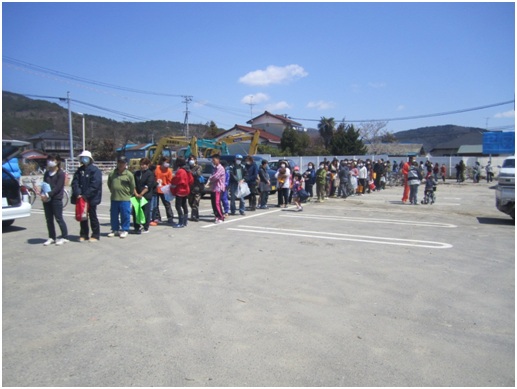
Second Harvest Japan (2HJ) started food supply to Ishinomaki right after the 3.11 disaster.  Since then 2HJ has been delivering relief supplies donated from individuals and companies to the Self-Defense Forces temporary warehouse in Ishinomaki City Athletic Park (until June), NGOs and NPOs based in Ishinomaki Senshu University, evacuation centers, and survivors living in temporary houses or in their houses every weekend until now. Since survivors living in their houses receive little relief supplies from the local government, 2HJ has been regularly holding supply-distribution events in areas such as Minato, Kazuma, Watanoha, and Shiotomi, where lots of residents suffered serious damages from the tsunami.

In having the distributions for people living in their houses in these areas, 2HJ has collaborated with Fare Trade Tohoku, a local NPO, which has been supporting survivors since March 11.


2HJ’s 4-ton truck has been very useful for our relief efforts in Ishinomaki. In this picture, the truck had just arrived at the WFP warehouse built in Ishinomaki Senshu University (April, 2011).


Unloading relief supplies in the Self-Defense Forces temporary warehouse in Ishinomaki City Athletic Park


Preparing for a supply-distribution event in Kazuma area in April, 2011


After eight months since the disaster, most debris has been cleared, and disaster areas are relatively clean now. More and more stores are reopened, and local people can enjoy shopping. But in areas devastated by the tsunami, local businesses have not recovered yet. Survivors there have difficulties in going for shopping without cars or bicycles. Furthermore, many people have lost their jobs. Food supplies for them are still strongly needed. 2HJ wishes to ask for your unfailing support so we can continue to provide relief supplies for survivors until they rebuild their lives and stand on their feet.


Tuesday, November 22, 2011

2HJ Comic - Costco Run


A cartoon artist, Roberto De Vido, created great comics explaining Second Harvest Japan (2HJ)‘s disaster relief. (Visit Roberto’s site here.)
In this comic, one of our volunteers, Mr. Sonoda, went to our partner, Costco, to pick up food donated by them and deliver the food to agencies.
After reading this, you must feel like volunteering at 2HJ! Please contact us at volunteer@2hj.org! You can be the next Costco driver!


You can view the whole comic here!


Wednesday, November 2, 2011

We delivered Häagen-Dazs ice cream!


We delivered Häagen-Dazs ice cream 


From September 29 to October 2, we delivered Haagen-Dazs ice cream to people who had been relocated to temporary housing and those still staying in their collapsed dwellings. These people depend almost entirely on donations and aid-assistance.

Haijima, the 2HJ staff member currently stationed in Sendai City, worked with a local organization to best decide the areas where we were to distribute the ice cream. In Sendai, staff members from Personal Support Center patrolling around the temporary housing development helped us with our ice cream distribution.

One member said “Even people who usually stay at their homes during distributions came out for the ice cream, which gave us good opportunities to talk to them.” When we asked those who had received ice cream how many residents other houses had, they tried to remember by saying, “How many people are at Mr. so-and-so's place?” A junior high-school student who helped with the distribution said, “It was fun because I got to talk to the other people in our neighborhood!” I could see the circle of local community grow a little bigger thanks to our ice cream distribution. 


We also distributed in the areas where people were still living in their collapsed houses. Even though these people’s houses have been recognized by the authority as "completely collapsed," they cannot be relocated to temporary housing as their house still remains. Many of these people rarely receive aid deliveries.

Everyone there looked forward to the ice cream distribution. One family came with all their family members to the community center where we distributed the ice cream. One child, surprised, with his eyes wide open said, “I never had ice cream as aid distribution before!” That made me smile!

Häagen-Dazs Japan, thank you very much for your donation!